
About
What Praxora Lab is, and how the practice is structured
Praxora Lab brings together named AI practitioners for speaking engagements, facilitated AI workshops and consulting work. This page sets out how that claim is substantiated, who leads the practice, and how to reach us.
The Name
What Praxora means, and where it comes from

Praxora is a coined name, not a word already sitting in a dictionary. It is built on the Greek root praxis (πρᾶξις), meaning "doing" or "action," with a Latinate ending grafted on to turn an abstract noun into something closer to a name, the same shift that turns "aurora" from a description of light into a proper noun. Read plainly, Praxora sits close to "the one who does," practice standing on its own two feet rather than describing someone else's.
Praxis itself has a longer history than most root words carry. Aristotle used it to name a category of activity distinct from theoria, knowing or contemplating something without any obligation to act on it, and distinct again from poiesis, making something, a building, a text, a tool, whose whole point is the object left behind once the maker stops. Praxis was neither. It was action undertaken for its own sake, action whose purpose is not external to it. The practical wisdom that governs it, phronesis, is the capacity to judge well inside one specific, unrepeatable situation, not the capacity to recite the general rule for it. Aristotle's underlying claim still holds up: knowing what is right and doing it are two different achievements, and the second one is the harder one, and the one that counts.
The word keeps resurfacing at points where thinking alone stops being enough, regardless of what else the person reaching for it believed. Roughly two thousand years after Aristotle, the same distinction between knowing and doing turns up in a philosopher's private notebook, not a manifesto:
Philosophers have only interpreted the world in various ways; the point is to change it. Karl Marx, Theses on Feuerbach, XI, 1845 (quoted here for its use of the Aristotelian distinction above, not for its economics)
A century later, Paulo Freire built an entire theory of education around the same root: praxis as a cycle of act, reflect honestly on what happened, then act again differently, on the premise that an education which produces people who can describe a problem beautifully and do nothing about it has failed at the only thing that mattered.
That is the specific gap Praxora Lab is named for. Not AI literacy, which is theoria, knowing about a technology without being on the hook for using it, and not a proof-of-concept demo, which is poiesis, an artefact that proves nothing once the room empties and everyone goes back to how things already worked. The harder, less photogenic work in between, a specific organisation acting, under its own governance, with people accountable for the outcome, is praxis. The name is not decoration sitting on top of the offer. It is naming the actual problem.
Philosophers have only interpreted the world in various ways; the point is to change it.
Karl Marx, Theses on FeuerbachPositioning
What Praxora Lab is, who it serves, and why it is hard to copy
Vision
Praxora Lab is built for organisations in Singapore, and exists for one problem: an organisation ready to move an AI pilot into something a board can govern, with no way yet to prove it's ready. A workshop here ends with a scored readiness baseline, a governance checklist and an execution roadmap built for that organisation, not a maturity report, a literacy course or a framework pitched at companies in general. Every session is led by a named practitioner with a track record anyone can check, and nothing is left to interpret after the room empties.
Mission
To close the gap between an AI pilot and an AI a board can actually govern, one session and one named practitioner at a time, without ever dressing up a gap in evidence as something it isn't.
Why this is hard to copy
That position holds up against a copy for three reasons.
- 01
A named framework, individually authored components
The S.C.A.L.E. framework, Score, Control, Act, Learn, Evolve, is Praxora Lab's own sequencing of an engagement. What fills each stage, the readiness assessment, the delegation model, the Return on Employee method, the S.E.N.S.E. framework, is individually authored and checkable on its own, not a shared industry template a competitor can license or imitate overnight.
- 02
A non-overlapping practitioner bench
Economics, governance, workforce transformation and delivery, by deliberate design. Assembling four people with that combination of real credentials takes years of relationships, not a roster page.
- 03
A compounding evidence base
Every workshop run adds to a private base of real readiness scores and governance outcomes across real organisations, built here openly from session one rather than claimed before it exists.
To close the gap between an AI pilot and an AI a board can actually govern.
MissionApproach
How the claim that this is real work is substantiated
The claim that this is a real practice, not a marketing shell, rests on specifics, not testimonials. Every named expert has a real, individually verifiable credential and engagement history, not a composite persona. Each workshop has a published curriculum, schedule and set of deliverables a participant can check the session against afterwards, not a vague promise of "AI training." The facilitator's own track record, engagement by engagement, is stated plainly on the experts page rather than summarised away.
Praxora Lab is a new practice, built in 2026 for the AI that exists in 2026. There is no decade of case studies to point to yet. What it offers instead is current thinking: frameworks with nothing outdated to unlearn, applied by practitioners who each bring two or three decades of experience in the disciplines underneath AI, economics, governance, delivery, without first correcting for methodology built before this technology existed. That is the trade being made here, stated directly rather than glossed over.

Team
Who leads the practice
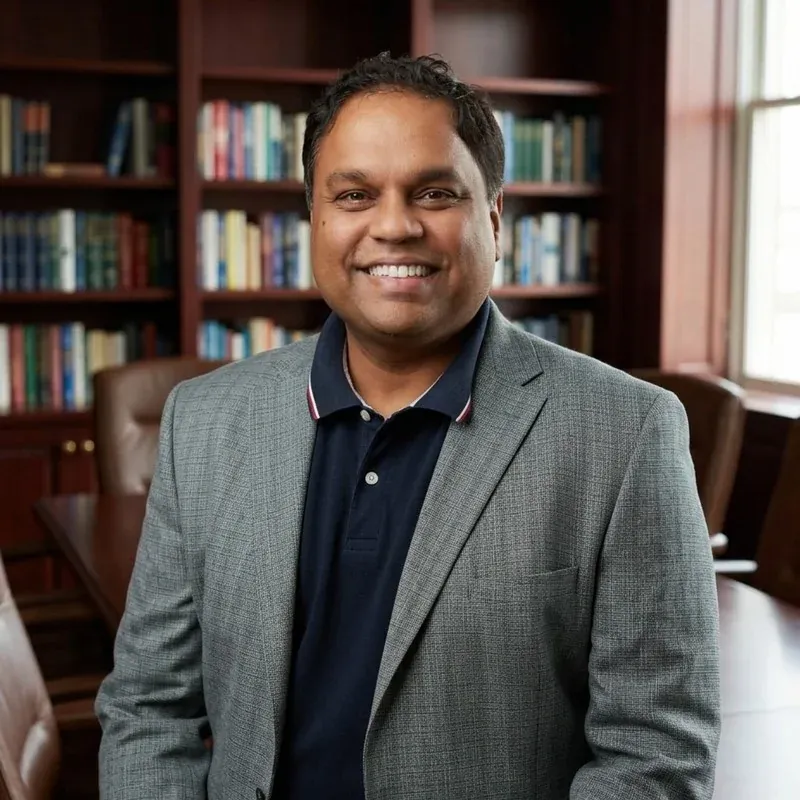
Founder
Dr. Jayarethanam Pillai
AI Economist
AI economist advising the UN Development Programme on AI and policy foresight and teaching as a professor of practice at Golden Gate University, with two decades spanning academic leadership, economic policy analysis and technology impact assessment across Asia, Central Asia and the United States.
Read the full profile ›
Co-Founder
Veronica Loh
Head, Operations, Praxora Lab · Managing Director & Chief Sustainability Officer, Orion Five Engineering
Twenty-six years managing business operations across logistics, food technology research and development, and the digitalisation of manufacturing and logistics operations, leading multidisciplinary IoT, ERP and robotics projects for government and private sector clients across Singapore and the region.
Read the full profile ›
Strategic Advisor
Terence Kok
Enterprise AI Strategist, Keynote Speaker · Former Chief AI and Innovation Officer, Meinhardt Group
Enterprise AI strategist with twenty-five years leading transformation programmes across Asia and the Middle East, specialising in impact assessment, governance and deployment methodology. Facilitates three of the courses and integrated programmes run at Praxora Lab.
Read the full profile ›Other named practitioners speak, facilitate and consult under the Praxora Lab banner alongside the founders and strategic advisor: see our experts for the full roster, and workshops for what they run. Every profile is a real person's own sourced credentials and history, published once confirmed rather than assembled from a template.
Making AI real: measurable, governable, and built around the people who use it.

Contact
General enquiries
For anything not covered by the workshop pages, use the enquiry form.
If your enquiry concerns a specific course, the pages themselves are faster: AI Governance & Board Readiness or any of the other five courses and three integrated programmes on the catalogue page.
Praxora Lab operates as Praxora Lab Pte. Ltd. (UEN 202639714K), a company incorporated in Singapore.